 In an earlier post entitled “Digital Downloads: Who Should Profit Most?” I ventured into the blogosphere to research what other authors were saying about the digital royalties debate and left my own comments and questions for them as well. This week, I will be blogging here and abroad about a similar topic, as the digital debate never seems to sleep. Of current interest to the music industry is the press release issued last week by last.fm, a free online streaming service that has distribution deals with four major music labels as well as numerous independents, and pays the labels each time one of their tracks is streamed via the site (sample player screen pictured, right). Last week, last.fm announced that since the service began offering free access to streaming songs from its five million track music catalog in January, not only has this generated a boost in new traffic to the site, but it has also resulted in existing users buying sixty-six percent more albums and individual tracks than they did before the free on-demand service debuted. Currently, bloggers are debating whether or not such a service has the power to change music listening trends and revive dying CD sales. As a new user of streaming sites such as last.fm and the hype machine and therefore involved in these trends, I was very attracted to this topic and chose to offer my own thoughts on two prominent blogs. The first post I came across, “What last.fm’s sales increase means to me” is written by Glenn Peoples, founder and editor of the Coolfer music industry blog. While last.fm solely credits its acquisition of free music streaming as the cause of new CD sales revenue, Peoples’ stance is that it is not just free music that has the power to increase sales, but rather the type of music service that is offered. The second post I found is entitled “Why last.fm’s free music won’t replace your music collection.” Written by Nate Anderson of Ars Technica, Anderson takes the position that despite the high quality and amount of free music, we should be skeptical of such a service and aware of its limitations, examining it from a larger, more cautious perspective. He believes that an ad-supported service such as last.fm always has financial interests at heart before concern for the user experience, and thus it will not be possible for last.fm to replace our music collections anytime soon, although it may be an enjoyable supplement if you can face the ads. In addition to posting my comments directly on the authors’ respective blog entries, I have also displayed these comments below.
“What last.fm’s sales increase means to me”
Comment:
Thank you for your careful analysis of the press release issued recently by last.fm. The release states that last.fm prides itself on helping “drive the discovery” of its users through its unique recommendation engine. However, I too have to wonder whether the ubiquitous statistic of a 119% sales increase is really all that dramatic of a figure. If the base sales amount was small, then a doubling of profits might not be as much as last.fm is proudly advertising, and may not be entirely attributable to the new free streaming as the company claims. On that note, I agree that a better portion of this number likely comes from users buying songs they already know and like after listening to them on the new on-demand service. Therefore, it is important for last.fm to accurately note the role that the type of service plays in relation to the sales, which you believe superior to the offering of free music alone. As you say, you have to “dig” into the press release to see last.fm co-founder Martin Siskel make this connection. However, either I disagree with your statement that listeners will “take a sure thing over online radio’s crap shoot any day,” or I simply represent one of the few “early-adopter types” in that “small slice of the bell curve” (pictured, below left). As someone who just recently began listening to last.fm and blog compilation sites such as The Hype Machine, I cannot stop tuning in, and these are almost entirely new artists, songs, and music genres for me. Surprisingly, I have discovered a few new artists that I enjoy by listening to random playlists selected by algorithms. In that case, it seems that streaming services like last.fm actually have helped drive my discovery of new music. Of course, if I am merely in
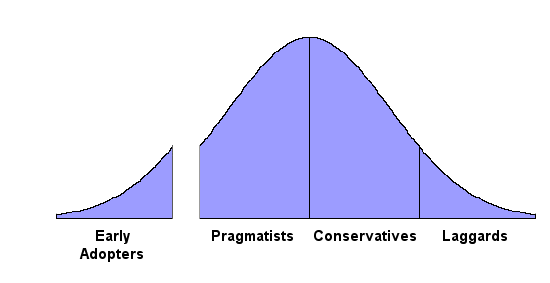 the minority here with my insatiable desire for new and less-mainstream music, I do understand how the majority of users would prefer on-demand streaming to non-interactive services. For the less adventurous, an on-demand service obviously delivers the songs and artists the listener will definitely enjoy and be more likely to purchase, which certainly may explain the sales increase. All in all, the connection between on-demand streaming and increased CD and download sales is an interesting one, and I look forward to seeing how it continues to play out.
“Why last.fm’s free music won’t replace your music collection”
Comment:
First of all, I would like to thank you for your well-researched and unbiased summary of last.fm’s advantages and drawbacks. Recently having read that last.fm’s sales through Amazon have increased 119% since the beginning of its free on-demand streaming, I wanted to see what the service was all about. As a brand new user, I agree with much of your account. Yes, the service works and is very responsive, but the ad-supported business model is frustrating. The whole point of such a service is for the user to have the ability to listen to their favorite artists and songs (as well as discover new ones) unlimited, for free; the three-time listening limit per track is a turn-off for me when I can listen to other full songs at sites such as The Hype Machine and Artist Direct without boundaries or advertisements. Artist Direct, for example, offers about two hundred free songs each week. If you are willing to take the time to individually download each one and organize them on your computer, your music collection really will increase in numbers pretty steadily and quickly. Granted, these free songs encompass all genres from heavy metal to Icelandic to international dance, so only a small portion will be likeable to the average user, and sorting through each takes a long time. However, the fact that last.fm does not allow free downloads and only partners with Amazon as opposed to iTunes severely limits its chances of making significant contributions to my music library. While you describe the possibility that the service may become the next “Music YouTube,” providing a legal way for friends to link up full songs for others to hear, ultimately I think that most listeners are primarily looking for a way to transport their music to external devices (and therefore permanently add to their music collection). If last.fm started a partnership with iTunes, I would be more likely to purchase songs that I first heard there. In the meantime, however, it certainly will not be replacing my music collection any time soon.


